


Table of Contents
- Convenience isn't the whole story
- Centrifugal extraction
- Slow pressing with an auger
- How to read the numbers
- Citrus features that change the result
- A reliable cleaning sequence
- Features worth prioritizing
- Start with the routine
- What wattage can and can't tell you
- Are electric fruit juicers worth it for daily use?
- Is electric juice as good as hand-squeezed juice?
- What works best in a small apartment?
- Does higher wattage mean more juice?
- What should I decide first?
An electric fruit juicer uses spinning blades or an auger to separate juice from pulp automatically, but extraction style affects yield more than motor power. The right machine depends on whether you value speed, maximum juice, easy cleanup, or a small countertop footprint.
If your morning routine starts with hand-squeezing an orange over the sink, you may wonder whether an electric fruit juicer really changes anything. And if a powerful machine produces a glass quickly, does that mean it extracts more juice from the same fruit?
Those questions expose the gap in many juicer comparisons. Speed, yield, texture, and cleanup are connected engineering choices, not separate marketing features. A fast centrifugal juicer can process firm produce quickly, while a slower press-style machine may leave less liquid trapped in the pulp. Neither design wins every kitchen.
Why Your Morning Juice Routine Deserves an Upgrade
A manual reamer gives you control, but it also asks you to repeat the same physical work for every half of citrus. An electric citrus juicer uses a motor to rotate the reamer, collect the liquid, and separate or manage pulp with far less effort. For someone making juice regularly, that consistency can matter more than the novelty of a high wattage label.
Electric fruit juicers became a recognizable household appliance category early in the twentieth century. The Sunkist, Jr. reportedly retailed for $14.95 around 1920, using a top reamer and side spout, a design that marked the shift from hand-squeezing toward powered home extraction. Later, centrifugal machines changed the process again by using spinning blades, as documented in this historical account of electric citrus juicers.
Convenience isn't the whole story
The important question isn't just whether a machine is faster. It's what the machine does with the fruit after you put it into the feed chute or press it against the reamer.
A high-speed centrifugal model may produce juice quickly, but the forceful spinning action can introduce more air and leave wetter pulp. A slow auger presses and folds produce, usually taking more time but aiming to recover more liquid. Citrus presses sit somewhere else in the design spectrum, because they're built around extracting juice from oranges, lemons, limes, or grapefruit rather than processing every type of produce.
Practical rule: Choose the extraction method before comparing wattage. Motor power supports the mechanism, but it doesn't determine the quality of the juice by itself.
The category remains commercially significant. One estimate values the electric juicers market at $1.69 billion in 2025 and projects it to reach $2.93 billion by 2034, with a 6.2% CAGR over that forecast period, according to electric juicer market coverage. That growth makes sense for households seeking repeatable beverage preparation, but it also means shoppers face more confusing specifications.
A useful upgrade reduces the work you notice every morning. It should produce the texture you like, handle your usual fruit without stalling, and be easy enough to clean that it doesn't remain unused on the counter.
How an Electric Fruit Juicer Separates Juice from Pulp
An electric juicer performs three basic jobs. It breaks or compresses the fruit, moves liquid away from solids, and directs both outputs into separate paths. The internal mechanism determines how aggressively each job happens.
Centrifugal extraction
A centrifugal juicer works much like a salad spinner with a cutting stage added. You place produce into a chute, a fast-spinning blade breaks it into small pieces, and a perforated basket throws the mixture outward. Juice passes through the fine mesh, while pulp stays in the basket or moves into a separate container.
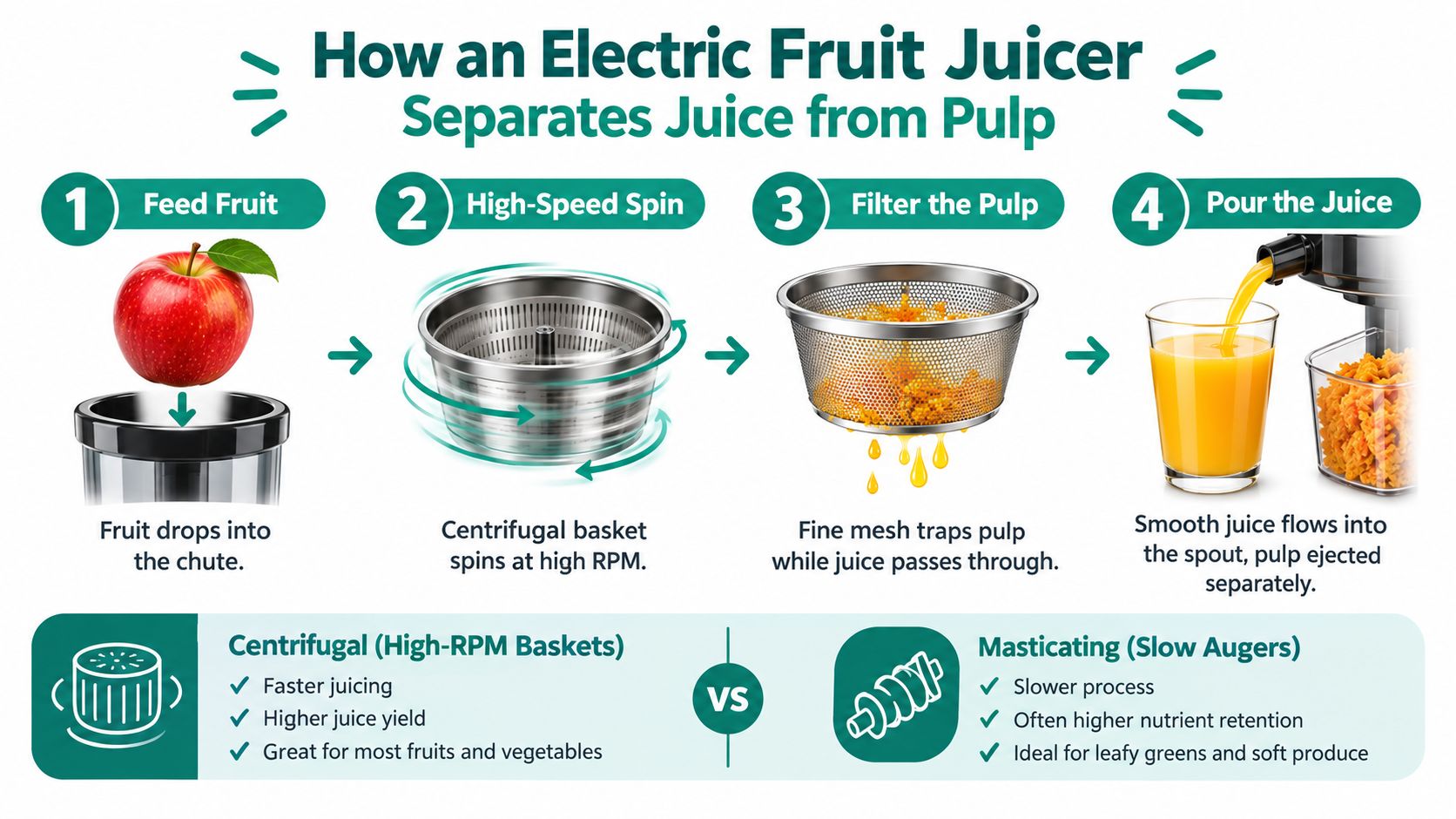
This design favors throughput. The basket's high rotational speed creates strong separation forces, so firm apples and other water-rich produce can move through quickly. The tradeoff is that fast cutting and spinning tend to pull more air into the drink, which can create foam. The pulp may also retain more moisture than it would after pressing.
Centrifugal machines suit users who want juice immediately and don't mind foam or a less uniform texture. They can also be simpler for occasional batches because the wide feed chute on some designs reduces preparation, although the basket still needs careful cleaning.
Slow pressing with an auger
A masticating or slow juicer uses a screw-shaped auger. Instead of chopping fruit and flinging it outward, the auger crushes and folds produce against a screen. Think of wringing liquid from a damp cloth, except the auger applies pressure continuously as the material moves forward.
The slower motion generally introduces less air and produces a denser, often smoother drink. It also handles fibrous ingredients more deliberately, though soft fruit can create a wet mixture that needs the correct screen and feeding pace. The machine's slower workflow may be a poor fit if your priority is getting a large batch finished rapidly.
Speed changes the result because it changes the way the fruit is broken apart. High RPM creates shear and separation force, while pressing relies more on compression and controlled movement. That's why two electric juicers can process the same orange but deliver different amounts of foam, pulp, and liquid.
For a visual explanation of the operating sequence, this electric juicer demonstration shows how produce moves through a powered extraction system.
Juice Yield and Extraction Efficiency Explained
Wattage is one of the easiest specifications to compare, but it isn't a direct measure of juice yield. Yield tells you how much of the input becomes juice, while extraction efficiency describes how effectively the machine removes liquid from the available material. Those figures answer different questions.
Independent review data for orange-juice extractor machines reported an average juice yield of 41.6% and juice extraction efficiency of 57.4%, according to commercial citrus extractor performance data. In plain language, a substantial portion of the orange's mass can remain in the pulp, peel, membranes, or other separated material.
That doesn't mean the machine is defective. Citrus contains solids and structure that aren't intended to become liquid. It does mean that a machine producing juice quickly may not be using the fruit as efficiently as a slower press.
How to read the numbers
Suppose two machines process the same type and quantity of fruit. One leaves a visibly wet pulp mass, while the other produces a drier output. Even if the first machine has a stronger motor, the second may deliver more usable juice because its reamer, auger, screen, pressure path, or operating speed better matches the fruit.
Higher-performing testing has reported maximum juice output around 77.6%, extraction efficiency of 85.3%, and extraction loss of 6.5%, showing that machine design and operating conditions can create large performance differences. These figures come from juice extraction research data, and they shouldn't be treated as a guaranteed result for every home machine.
Use yield information to think about three practical costs:
- Produce cost: Better extraction can make expensive fruit go further.
- Waste handling: Drier pulp generally means less liquid is discarded.
- Daily effort: A machine that extracts more but takes much longer to assemble and clean may still discourage regular use.
The best comparison is not “Which motor is strongest?” It's “Which design gives me enough juice, in the texture I prefer, with a cleanup routine I'll follow?”
Centrifugal vs Slow Juicers for Different Fruits
No electric juicer handles every fruit in exactly the same way. Firm produce gives a centrifugal basket something solid to cut and separate, while stringy or delicate ingredients can expose the limits of a fast blade system.
Centrifugal models are practical for apples, oranges prepared for the correct chute or attachment, and other firm, juicy produce. They prioritize rapid processing and often produce more foam. Slow juicers are better suited to users who care about a controlled texture, lower aeration, or extracting liquid from fibrous ingredients such as leafy greens and wheatgrass.
| Juicer Type | Best For | Avoid For |
|---|---|---|
| Centrifugal | Firm apples, quick batches, users who prioritize speed | Very soft mixtures, maximum yield goals, foam-sensitive drinks |
| Slow or masticating | Fibrous produce, leafy greens, dense blends, users focused on extraction | Routines where rapid processing matters most |
| Electric citrus press | Oranges, lemons, limes, grapefruit, adjustable pulp preferences | Whole mixed-produce recipes and ingredients that require an auger |
Citrus features that change the result
Pulp control is more useful than it sounds. One tested electric citrus juicer offers three pulp settings, allowing a smoother, medium, or more textured drink, as described in this citrus juicer review.
Reverse or auto-reversing action can also help. A citrus cone that changes direction or uses dual rotation works the fruit from more than one angle, which product documentation identifies as a way to improve extraction. This overview of citrus juicer features describes reverse juicing action as a specific extraction aid.
Your choice should follow your menu. If you mainly want orange juice before work, a citrus press may be more sensible than a full produce juicer. If you alternate apples, greens, and fibrous ingredients, a slow system may justify its larger footprint and longer cleaning routine.
Cleaning Tips and Convenience Features That Actually Help
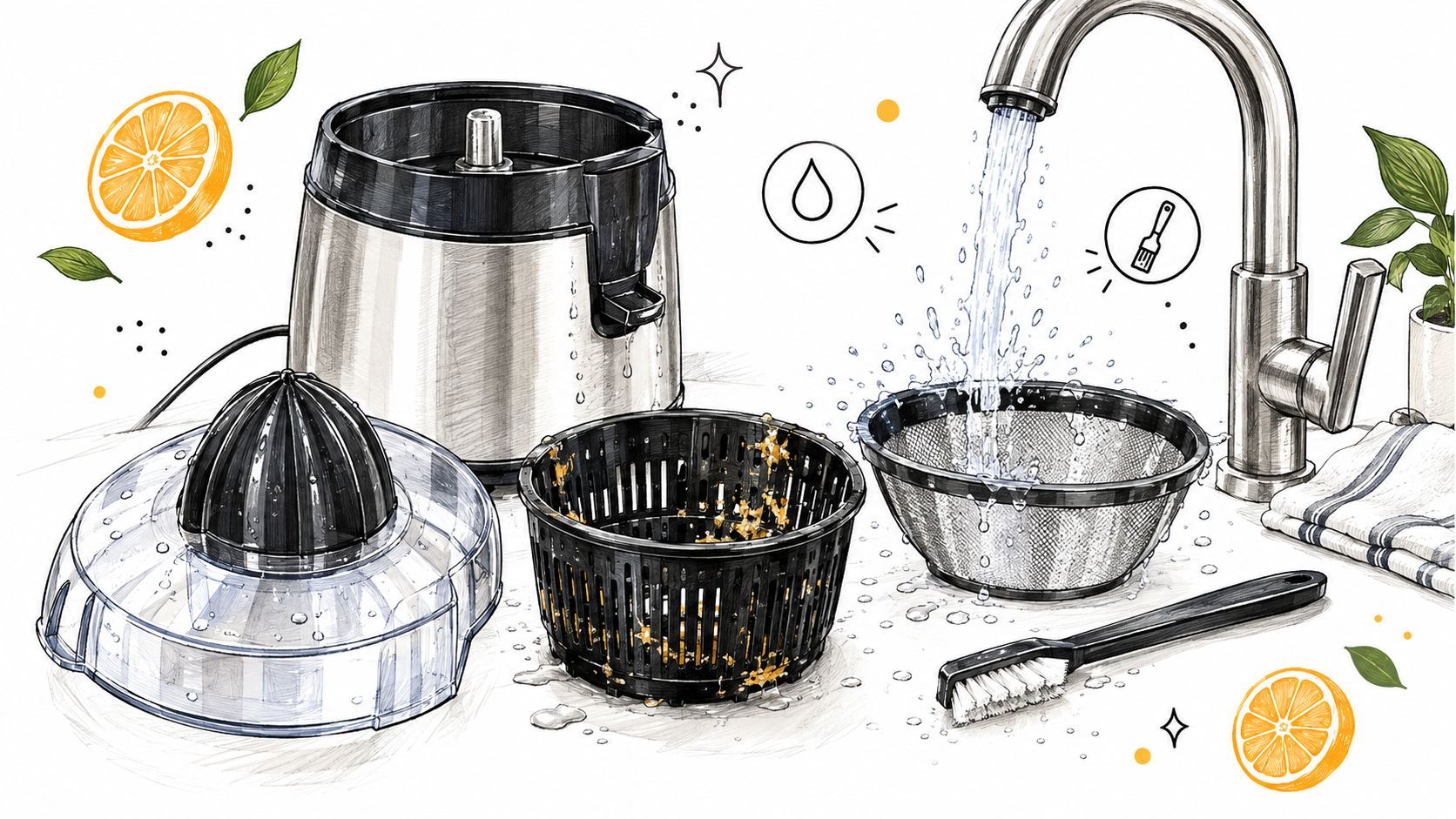
A juicer earns its place in the kitchen only when cleanup feels manageable. Juice residue dries quickly around mesh screens, pulp containers, seals, and narrow discharge channels, so delaying the rinse turns a short task into a scrubbing project.
A reliable cleaning sequence
- Unplug the machine first. Don't handle the cutting basket, auger, or reamer while the motor is connected to power.
- Empty the pulp container immediately. Wet pulp is easier to remove before it dries and hardens.
- Separate removable parts. Take off the lid, pusher, bowl, screen, basket, spout components, and seals according to the product manual.
- Rinse before brushing. Running water loosens fibers and reduces the force needed to scrub the mesh.
- Brush the screen carefully. Blocked holes reduce flow and can make the machine appear less efficient.
- Dry parts fully. Moisture left inside seals or crevices can create unpleasant odors.
Features worth prioritizing
Automatic pulp ejection helps during repeated batches because the machine sends solids into a dedicated container rather than forcing you to stop as often. It doesn't eliminate cleaning, but it can make continuous use less interrupted.
Dishwasher-safe parts may save time, provided the manufacturer approves that method. A self-cleaning cycle can loosen residue, but it shouldn't replace manual attention to the filter, screen, or seals. Fewer parts and accessible surfaces often matter more than a long feature list.
Cleanup test: Before buying, look at the filter and pulp path. If you can't easily see where fibers collect, assume you'll spend more time maintaining it.
The simplest useful routine is to rinse the parts as soon as the glass is poured. That habit protects the machine's flow path and keeps the next use from starting with yesterday's dried fruit.
Choosing the Right Electric Juicer for Your Kitchen
Choose based on how you'll use the appliance, not how impressive its specification sheet looks. A person making orange juice every morning has different needs from someone processing mixed produce on weekends or carrying a small device to work.
Start with the routine
A compact electric juicer works well when storage space is limited and the expected workload is light. It can be easier to keep accessible, which matters because an appliance hidden in a cabinet is less likely to become part of a daily habit. The compromise may involve a smaller capacity, slower batch work, or less resistance to demanding ingredients.
A full-size centrifugal model makes more sense for firm produce and quick preparation. A masticating model suits buyers who place greater value on extraction efficiency, texture control, and fibrous ingredients than on immediate throughput. For citrus alone, a dedicated electric press can avoid the unnecessary bulk of a multifunction machine.
The Portable Fruit Juice Blenders Summer Personal Electric Mini Bottle is listed with the GIOIO brand name, a capacity of less than 500 ml, automatic pulp ejection, and power below 200 W. Those specifications position it as a compact personal option, so evaluate it against your portion size and ingredients rather than comparing its wattage directly with a countertop extractor.
What wattage can and can't tell you
Commercial machines show why power should be read alongside other specifications. One industrial extractor lists 800 W, 3,000 RPM, and up to 2 liters of juice per minute, while another specifies a 250 W ventilated motor designed to help minimize auger blocking. These examples appear in commercial juicer specifications.
A higher watt rating can improve overload resistance, consistency, and uptime during demanding use. It doesn't automatically produce better-tasting juice or higher yield. Check the RPM, continuous-duty language, blocking protection, overheat protection, screen design, and cleaning access before treating wattage as a buying shortcut.
FAQ About Electric Fruit Juicers
Are electric fruit juicers worth it for daily use?
They can be, especially if manual squeezing has become a barrier to making juice. The value comes from repeatable extraction and reduced physical effort, but the best choice still depends on whether you prioritize speed, yield, texture, or cleaning time.
Is electric juice as good as hand-squeezed juice?
It can be fresh and enjoyable, but the texture may differ. High-speed machines often create more foam, while a citrus press or slower system can give you more control over pulp and mouthfeel.
What works best in a small apartment?
A compact model or dedicated citrus press usually makes more sense than a large multifunction machine. Measure storage space, check the cleanup process, and choose a device you can leave accessible or assemble quickly.
Does higher wattage mean more juice?
No. Wattage supports motor strength and resistance to overload, but extraction style, screen design, operating speed, and fruit preparation have a greater effect on yield. Compare the whole machine, not one number.
What should I decide first?
Decide whether your priority is rapid juice, maximum use of expensive produce, or the easiest cleanup. That speed-yield-cleanup triangle will narrow the choices faster than a generic “best juicer” list.
Zenvora offers practical home and kitchen gadgets, including compact electric tools for everyday routines. If a small personal juicer fits your portion size and produce habits, visit Zenvora to browse the current catalog.
Authored using Outrank